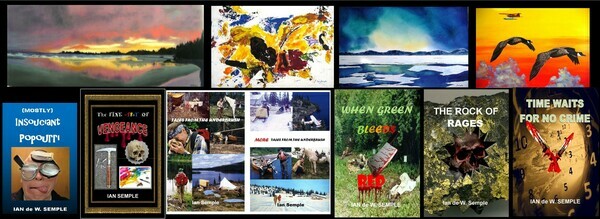
”Tales From The Underbrush” documents, with occasional hyperbole, the experiences of the artist over a lifetime of interaction with what used to be called nature, now reinvented as the environment for reasons apparently best known by just about everyone in the world excepting the artist-writer. These wilderness interactions have come mainly while working as a geologist, briefly as a forester, but sometimes as just a guy whose principal happiness in life has been derived from being outdoors. Not that life in the wilderness, be it at work or at play has been without pain, discomfort, deprivation and even danger. Fortunately, the passage of time more often then not artfully blots out or at least dims the recollections that wound, substituting instead a recall that if perhaps not substantiating the aging athlete’s jest of “the older I get, the better I was”, at least allows tales to unfold that warm the memory and give substance to the life that experienced them.
The artist proposes to post monthly herein a chapter from his book “Tales From The Underbrush” in the hope that his adventures may be shared and enjoyed by those who might stumble onto this blog. This month’s entry continues the tale.
THE REALITY OF THEORY – Part 1
“It is amazing how much theory we can do without when work actually begins.”
Ernst F. Schumacher (1911-1977)
“In theory there is no difference between theory and practice. In practice there is.”
Yogi Berra (Baseball Hall of Fame)
It was not during “the summer of ‘69” as the song goes, when the events of this tale took place but rather a decade earlier. A day or so after the semester’s final university exam in April of 1959, I headed for the town of Chibougamau in northern Quebec. There, I met the members of the exploration mapping party I was to join and with whom I was to live in close contact for the next five months or so. It was my first summer in the bush and I had been hired as a junior geologist by the Quebec Department of Mines to be part of a seven man crew that was to geologically map a large section of country some 200 kilometres northeast of Chibougamau, in an area northeast of Lac Mistassini, at 176 kilometres long and 40 kilometres wide, the largest lake in Quebec.
The party I was to join was headed by a Chief Geologist, in this case an experienced Ph.D. geologist from whom I was to learn a considerable amount and have large respect. Under him was a Senior Geologist, two junior geologists including me, plus a cook and two bush men. The latter provided the bulk of the grunt work around camp, chopping wood, building docks and camps when needed, acting as canoe men, and generally lending their bush experience as required. The cook of course was the camp deity to whom all deferred, either out of respect or fear. With food being about the only source of entertainment never mind sustenance for five months, keeping the cook happy was a key strategy to maximizing one’s well being and survival over that period of general deprivation.
The method of geological mapping a large area of hundreds of square miles was to conduct walking traverses that systematically covered the assigned map area. The objective was to produce a map on a scale of one half inch to a mile, meaning that every one half inch distance on the map was equivalent to one mile of length on the ground. On this map would be plotted the type and structure of rocks encountered along the traverses conducted. In those pre-computer days, one of the most important functions of a junior geologist was in physically colouring these maps with coloured pencils, hopefully drawing on his kindergarten background for the expertise. Added to this job function was one of digging the latrines when a new camp was being established. While one would think that perhaps this was a job for the bush men, the latter’s skills in cutting and preparing tent poles and erecting a new camp were not only more important but generally far beyond the abilities of the typical junior geologist. The latter were thus reduced to digging holes.
The more formal role of the junior geologist was to accompany the party Chief or Senior Geologist on traverses. Aside from acting as a safety factor to unaccompanied travel in the bush, the primary duty of the Junior Geologist was to reproduce as accurately as possible on the ground the planned traverse routes as plotted on a map. There was nothing of geology in this responsibility. But then again, few of us new to this position had any experience in the reality of examining and mapping rocks in the real world outside the cozy confines of academia and book learning. The latter concept was to form the crux of what was soon to develop for me that summer.
Maintaining an accurate traverse line through the bush in the days before satellite navigational devices came into being employed a seemingly primitive but still very effective and accurate method if conducted with some skill, and when considering the scale of mapping being conducted in our case. A traverse route was plotted not only on a map, but if you were lucky to have had your mapping area flown and aerially photographed, the same route could be plotted on a black and white aerial photograph. These latter were developed on photographic paper about nine inches square, with portions of the area covered by one photograph overlapping that of the next one consecutively taken. Manipulating the common overlapping portions of such two consecutive photographs under special viewing lenses allowed the observer to view part of the land in the photos in simulated three dimensions. Thus, the relative height of hills or mountains along a traverse route could be ascertained beforehand. The use of aerial photos was a major aid in recognizing where on the ground one might be located at any one time along the traverse route. While such photos might be deemed as a fool-proof aid for location purposes, even for the most inexperienced of juniors, that in fact was not the case. Inaccuracies around the margins of a photo due to camera lens distortion caused errors in the shape of objects and in horizontal distance measurement on that part of a photo, a portion that might comprise about 50% of the photo’s total area. Also, although three dimensional viewing was helpful in delineating the nature of the ground to be traversed, the vertical aspects of this viewing also contained significant distortion. Nevertheless on balance, aerial photos provided a valuable aid to topographic maps in managing one’s way along the intended bush route of a traverse. The rest was up to the person responsible for properly navigating the reality.
On the scale on which we were to map that summer, the route of the traverse on the map or photo might approximate a long rectangle or parallelogram, the two long sides separated by one half mile on the ground, or one quarter inch on a map. This route was of course a planned and idealized one, hopefully to be maintained in reality. It also assumed that no lakes or other major obstacles were in the path of the planned traverse lines. Regardless of whether the traverse was a simple rectangle or whether lakes, swamps, cliffs, rivers or other natural barriers necessitated a more complicated course, a traverse route would nonetheless comprise a series of straight lines as the traverse went from one recognizable geographic location along the route to another, eventually “closing”, that is to say returning to the starting point of the traverse. Maintaining the actual route through the bush as well as accurately locating any one point along the traverse, such as the location of an outcropping of rock encountered, was, as has been said, the responsibility of the junior geologist. The methods for such location tracking have been alluded to in “Cheap Trills” but just in case someone ripped that essay out of the book at the library I will briefly review them again here.
The direction of the various “legs”, i.e. route lines of the traverse were maintained by way of a hand held compass, most often in my day being of a famous type known as the Brunton compass, still in use and named after its Wyoming manufacturers. This compass measured not only direction but angles of inclination, a valuable function for geologists when measuring not only the direction of a rock’s structure but also its inclination from the horizontal. Distances through the bush along the lines of the traverse were kept track of by a little counter one held in one’s hand. Knowing the length of one’s stride, being say two and a half feet in my case, and clicking the counter every fourth stride meant that each click on the counter corresponded to ten feet of horizontal distance on the ground.
With experience, one developed an instinct for making unconscious corrections when the realities of nature prevented the reproduction in the bush of the idealized straight traverse lines plotted on a map or photo. Such realities included going around trees rather than through them, or detouring around unexpected bodies of water, be they small lakes or beaver dams not noted on a map or photo. Such diversions were in lieu of walking on water, which challenged even the most experienced of junior geologists. Since climbing steep hills and mountainsides does not even approximate horizontal travel and the measurements thereof, compensations had to be made for such occurrences, lest the rocks encountered on a traverse and plotted on a map end up being located in another province!
So it was that our first camp had been set up that summer, if not without some difficulties involving your humble scribe (see the chapter entitled “The Entertainer”). Our Party Chief that summer, let’s call him Ted, was a bluff and burly Ph.D. graduate; Canadian, experienced, tough, conscientious and demanding of the job at hand, but with a sense of humour that is so important when coping with the potential problems of a small group of men living and working in close quarters under conditions of deprivation over the course of five months in the bush. The Senior Geologist, let’s call him Perry, was somewhat of a contrast to Ted. A bespectacled post graduate Masters degree student from a prestigious academic institution in the New England states, he was as I recall, in the midst of pursuing a Ph.D. degree in geology. But that, and a sense of humour which was to ironically lead to his downfall, were the only elements of commonality with Ted. Needless to say, neither of them had much in common with the wide-eyed, know-nothing junior geologist that was me. As was the case in nearly every instance, and a probable policy of the Quebec Department of Mines that employed us, none of the members of our mapping party had before worked together, or excepting perhaps the canoe men, had even known each other.
It was a sound policy of Ted to have the two junior geologists rotate between working with him and with Perry, the former two hopefully gaining from the latter two a good blend and diversity of knowledge and experience in the process. As I recall, I was assigned to work with Ted as my first step to becoming a legitimate and useful field geologist. Over the ensuing several weeks and in the course of coping with a horrific new enemy to me known as the black fly, I became a veritable sponge, eagerly soaking up the teachings of both geology and bush that Ted so readily imparted to me. Black flies aside, my confidence grew daily, and having been raised with a strong work ethic, I believe that while my rookie status remained obvious, Ted increasingly gained respect for the effort and conscientiousness I put into the job.
TO BE CONTINUED
Copyright © 2010 Ian de W. Semple